Maybank Numismatic Museum
Important Note: This museum is currently closed as it is undergoing upgrading work. We would suggest that you visit Bank Negara Malaysia Museum and Art Gallery instead.
Maybank Numismatic Museum is located in the city centre of Kuala Lumpur in the Maybank Tower near Puduraya. Although not as comprehensive and decorated as well as Bank Negara Money Museum, it has an impressive collection of coins and notes that go way back to the time of the Malacca Sultanate, the occupation of Malaya by the Portuguese, Dutch, British and Japanese during "World War 2.
For students who are serious on the history of numismatic, this museum is a good place to go to enhance your knowledge in this area. The exhibit was officially opened by the then Bank Negara Governor, Tan Sri Dato Jaafar Hussein on 9 January 1988.
The numismatic collection include the following :
- Miniature Cannons were used in Borneo as currency by the natives. They were used for bartering, wedding gifts and for barter trading. A real cannon is usually fired during weddings, births and visits by the VIPs.
- Malacca Sultanate 1400-1511 merchants used gold dust, silver bars and blocks of tin instead of coins. As more traders come in from the Middle East, Pasai coins were introduced during the reign of Sultan Muzaffar Shah.
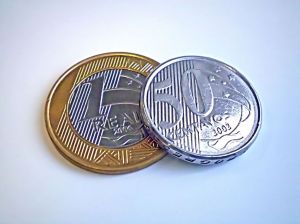
Coins.
- Portuguese Occupation 1511-1641 saw the introduction of the currency in the form of gold catholico, the silver malaquese, bastardos, soldos and dinheiros in an alloy of tin and lead.
- Malay States Currency in the form gold coin called "mas kupang" was used during the reign of Sultan Abdul Jalil Shah III from 1623-1677. In Kedah, the animal currency in the form of fighting cock was used in the 16th century. Tin ingots currency in the shape of an elephant and crocodile were used in Selangor and Perak.
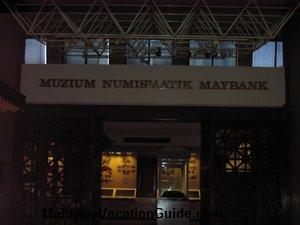
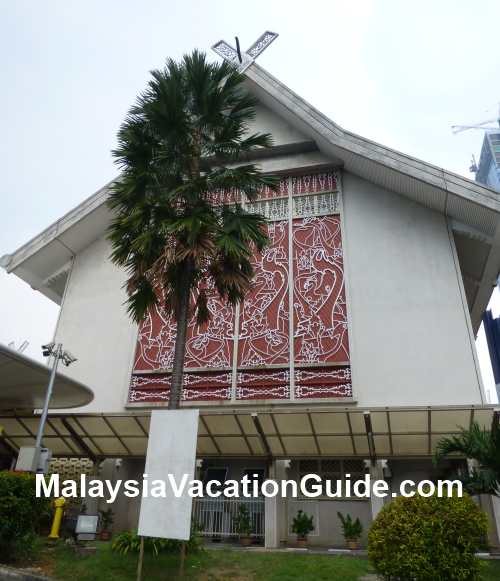
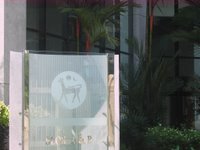
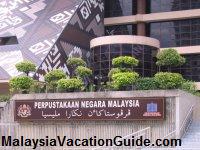
The entrance to Maybank Numismatic Museum in Maybank Tower.
- Straits Settlements 1826-1939 which were formed by three settlements of Penang, Singapore and Melaka began to use coins that were issued from the year 1826-1939. Many of the coins were issued during the reign of three English monarchs. They were Queen Victoria, King Edward VII and King George V.
- Foreign Currencies issued by Brunei, Singapore, Indonesia, Thailand and the Phillipines are also on display here.
- Private Bank Notes used in Melaka and Penang are also shown here. The special currency notes used at Sungai Buloh Leprosarium was introduced in 1935 and was used only within the Sungai Buloh Leprosy Settlement. It was believed that the used of normal currency can lead to the spread of the disease.
- Bank Negara Malaysia first issued currency notes in June 1967 with denominations of $1, $5, $10, $50 and $100. A $1,000 denomination was issued on 2 September 1968. In the year 1982-1984, new design of currency notes of $1, $5, $20, $500, $10, $50, $100 and $1,000 with emphasis on Malaysian characteristics and security were introduced.
Getting To Maybank Numismatic Museum
The museum is easily accessible to the public as it is located in the city centre. Take the PUTRA LRT and stop at Masjid Jamek station. The museum is located in Maybank Tower and is about 10 minutes walk away. Alternatively, take the STAR LRT and stop at Plaza Rakyat Station. You will reach the building in approximately 10 minutes walk.
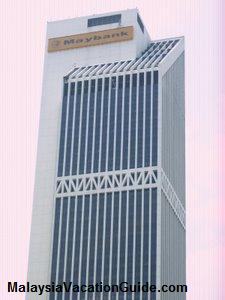
Menara Maybank.
Opening hours
10:00am - 6:00pm (Mondays to Fridays)
The museum is closed on Saturdays and Sundays.
Admission Fee
Admisson to the museum is FREE.
Further information can be obtained by calling Tel: +6 03 2074 7418.
Address
1st Floor,
Maybank Tower,
Jalan Tun Perak
Terengganu | Perak | Malaysia Hotels | Airlines | Shopping
Pulau Perhentian | Beaches & Islands | Highlands | Theme Parks
Museums & History | Landmarks | Public Transports | Videos
Souvenir | Calendar 2026 | Tourism Centre | Cyberjaya | Golfing
Penang Food | KTM | Beruas Museum | Selangor | Templer's Park
Pulau Ketam | KLIA2 | Pulau Sibu | Advertise With Us
Recent Articles


-
Museums In Penang
 Visit the many museums in Penang to learn more about the heritage of this historical state.
 -
Penang Clan Jetties
 Visit Penang Clan Jetties to learn more of the culture and history of these jetties. Get some souvenir and food while you are here.
 -
Penang Street Art Murals and Wrought Iron Caricatures
 See Penang street art by taking a walk in Georgetown Heritage during the daytime. Murals and wrought iron caricatures are placed all over Georgetown. Enjoy...
 -
Penang National Park
 Penang National Park is the place to go if you enjoy nature, flora and fauna, bird watching, photography, camping, canoeing, fishing, swimming or just to sweat it out using the trails..
 -
Penang Food
 Penang food is one of the main reasons why tourists are flocking to this state during the public holidays besides the beaches and the mountains.
New! Comments
Have your say about what you just read! Leave us a comment in the box below.